Home » International Conference on Micro, Nano, and Smart Systems – IC-MNSS, 2024
EVOLUTION AND THE ORIGINS OF BIOLOGY AND LIFE
“The word evolution is most closely associated with Darwin and Biology. Yet it is the word that changed physics in my lifetime.” These are the words used by the physicist Jacob Bronowski in his now classic narration of “The Ascent of Man”, in the 1970s on BBC television. Bronowski is at that point trying to explain the formation of the chemical elements in the stars, by nuclear fusion processes, and concludes “matter itself evolves”. Indeed, all the natural elements, present on Earth and accessible by mining, were the Earth’s inheritance when it was born. Geological and chemical evolution must necessarily precede evolution of life on Earth. For almost the first 1.5 billion years, of its almost 4.6 billion years of existence, the Earth was devoid of life forms.
Biology rests on a remarkably intricate canvas of biochemistry. A living cell is throbbing with chemical activity. Interlinked metabolic pathways, finely regulated, synthesise and degrade the molecules necessary for cellular functions and cell division. In Arthur Kornberg’s words “chemistry is the lingua franca of biology and medicine”. How did cellular chemistry evolve? Is there a convincing model for the formation of the first cell? Did cells evolve in a primordial soup of molecules as postulated by Alexander Oparin and J. B. S. Haldane or are soup scenarios too simplistic? Are there plausible pathways for the prebiotic formation of precursors of the molecules of biology? These and many other questions on chemical and early biological evolution do not have firm answers based on incontrovertible evidence. Speculation is a legitimate approach towards constructing evolutionary scenarios and to build hypotheses which might be testable.
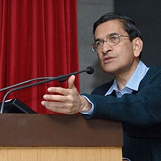
Former Director of IISc, Visiting Professor at NCBS, Bengaluru
Prof. P. Balaram is a world-renowned biochemist who extensively worked on conformational analysis and structure of natural and engineered peptides. He joined the Indian Institute of Science (IISc) as a faculty member when he was just 24 years old and remained there for four decades until his superannuation in 2014. He served as the Director of IISc from 2005 to 2014.
His penchant for the history of science, research as a lifestyle, and science policy is evident in the incisive editorials, 304 in total, that he wrote in Current Science between 1994 and 2013 with a short gap of 18 months. An eloquent speaker, Prof. Balaram is admired by all for his clear articulation of ideas with riveting diction.
He is recognized with the Shanti Swaroop Bhatnagar Prize (1986), The World Academy of Sciences (TWAS) Prize (1994), Padma Shri (2002), Padma Bhushan (2014), and R. Bruce Merrifield Award (2021) at the American Peptide Symposium, among many other honors. He is currently a Visiting Professor in the National Centre for Biological Sciences, Bengaluru.





Last date to file nominations is 31.07.2026.
ISSS has initiated a Technology Award for scientists/engineers who undertake major initiatives to commercialize a product in the area of micro and smart systems. The award will carry a Citation and a Cash prize of Rs 50,000.
This award is intended to promote technology development, innovation and entrepreneurship in India in the area of micro and smart systems. This award is intended to recognize contributions made by (i) an entrepreneur who has set up, or is at an advanced stage of setting up start-ups pertinent to the general area devices or systems using micro and nano technologies and applications or (ii) someone who have championed the cause of commercialization with appropriate technology innovation, leading to a product or application.
Please note that the nominee is expected to have demonstrated maturity towards commercialization of the product or has made sustained progress towards commercialization during the recent years. Documentary proofs for claims may be included with the nomination form. Nominations for this award in the prescribed format may be sent to admin@isssonline.in by the deadline and may be made by self, head of organization or ISSS members.
Nomination by “self” should be supported by reference letters by two experts familiar with the nominee’s work. Nomination by an ISSS member or the Head of Institution should be seconded by another ISSS member or a subject expert. Nominations will be valid for up to three years.
Nomination format is available online. Nominations may be sent to admin@isssonline.in.
The winner is required to make a short presentation summarising his/her activities and receive the award at a special session at the ISSS conference. In order to keep the standards high, the judging panel may choose not to offer this award in a given year.
ISSS presents distinguished service awards to deserving individuals who have made outstanding contributions to the research and development of the Micro and Smart Systems areas in India through their academic or professional work, service to ISSS or service to national initiatives/programs. Nominees are selected solely by the Governing Council and no nominations or representations are solicited for this special honor. In the past, society have recognized the following individuals
ISSS has instituted special student awards for full time regular students in India to recognize their outstanding contributions in the area of micro and smart systems. There are separate categories for undergraduate (BSc, BE, BTech, etc) and postgraduate (MSc, MS, ME, MTech, MPhil, etc). To qualify for these awards, the student(s) should have completed the reported work during the respective academic programs.
A summary/synopsis of the research work during the tenure of the respective degree program may be sent for consideration for these awards. In the case of UG award, an individual or a team of up to four members can submit their contributions. For the UG award, a three-minute video describing the project outcome and for PG and PhD award a five-minute video describing the project outcome should be submitted.
Supervisor/guide of the student(s) is required to give an undertaking that the work was carried out during the respective academic course program for which the submission is considered. The Academic supervisor(s) of award winning students will be given a Commendation Certificate. Students of integrated degree programs may be considered for the award category based on their year of enrollment. Please note that one person will be considered only once for one category of award.
Submissions for these awards should be sent directly to admin@isssonline.in.
Award winners will be given a Memento, Cash prize as above, and an Award Certificate. The Academic supervisor(s) of award winning students will be given a Commendation Certificate.